
The Ibero-American Meeting is accredited by the Scientific-Pedagogical Council for Continuous Training as a continuous professional development (CPD) course, valid for teacher career progression across all subject areas and key stages. Accreditation Register: CCPFC/ACC-1441861/26
POSTERS
Invitation and guidelines for authors
Ladies and gentlemen:
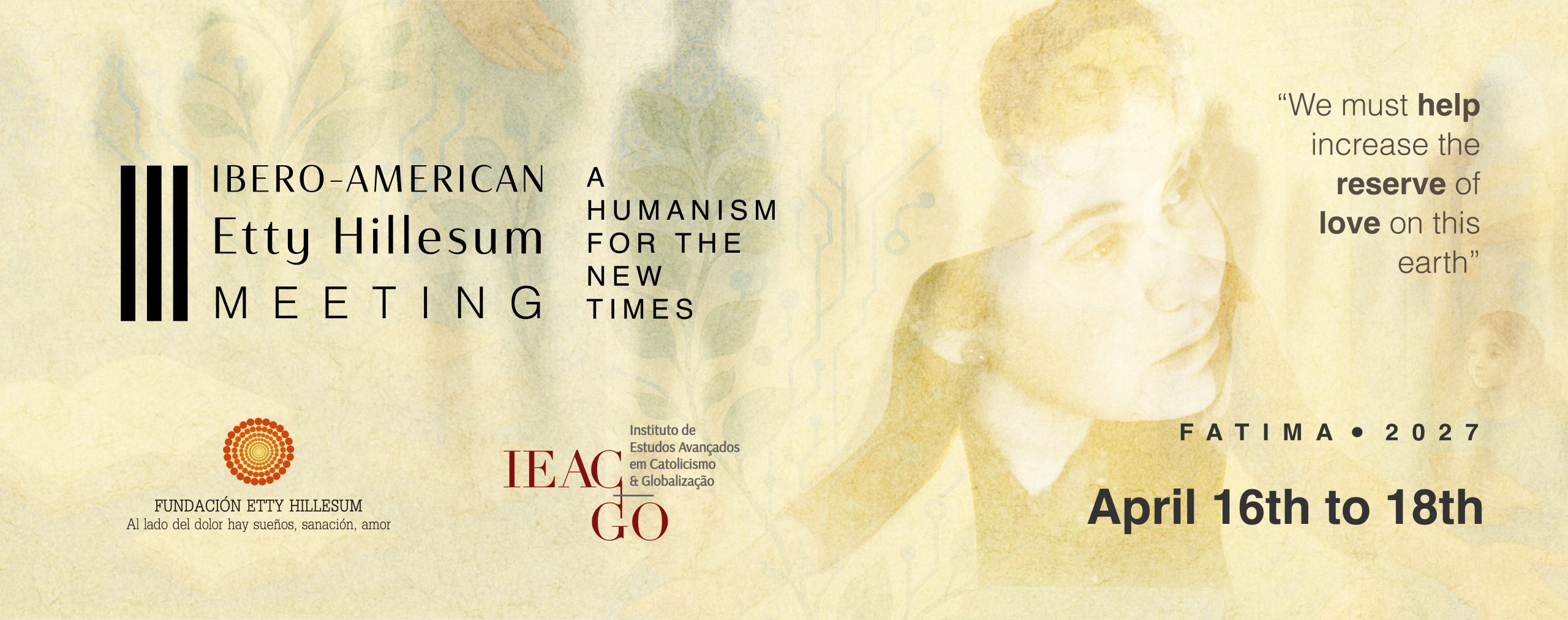
The III Etty Hillesum Ibero-American Conference: ‘A Humanism for the New Era’ will take place at the SDivine Hotel in Fátima, Portugal, at the invitation of the Institute for Advanced Studies in Catholicism and Globalisation, based in Portugal, and the Etty Hillesum Foundation, based in Colombia. The city of Fátima will have the honour of hosting a distinguished group of academics specialising in the humanities and social sciences.
We invite you to create posters inspired by the following proposal and thematic areas:
Humanism has been identified as the central theme, recognising that it is a term which, throughout history, has been interpreted in many different ways: from the anthropocentric shift in Ancient Philosophy, through the exaltation of human dignity in the Renaissance, to modern political and cultural projects that sought to build fairer societies by placing human beings at the centre.
In Etty Hillesum’s experience and writing, this concept takes on a profoundly personal and transformative dimension. For Etty, humanism is neither an abstraction nor a political programme, but a concrete way of being in the world, even amidst the most adverse conditions. Her testimony shows us that what is human is preserved and reinvented within our inner selves, in our relationships with others, and in the way we fulfil our responsibilities, both individual and communal.
From this perspective, the Third Etty Hillesum Ibero-American Conference: ‘A Humanism for the New Era’ aims to create a space for reflection and dialogue centred on an embodied humanism, capable of responding to today’s challenges. The thematic strands seek to shed light on central aspects of Etty’s vision: individual responsibility arising from inner work and the recognition of one’s own inner turmoil; love as an active force of resistance against dehumanisation; and radical empathy, which serves as a bridge towards building a more caring community.
In a global context marked by social fragmentation, violence and indifference, Etty Hillesum’s voice reminds us that transformation begins within each person but does not end there; it extends into our encounters with others and into the building of a shared horizon of meaning and hope. For this reason, this conference seeks not only to explore the richness of her thought, but also to draw inspiration from it to recreate a humanism that embraces vulnerability, promotes solidarity and increases, as she would say, the ‘reserve of love on earth’.
We propose the following thematic areas and guiding questions:
- Humanism and individual responsibility: on the role of personal responsibility in building a more humane world, following Etty’s premise of looking within and coming to terms with one’s own ‘chaos’.
- What role does spirituality play in shaping individual responsibility?
- What role does spirituality play in building a sense of communal responsibility?
- On what criteria is individual responsibility based in Etty Hillesum’s proposal?
- How can we conceive of individual responsibility without falling into individualism?
- Love as active resistance: Etty Hillesum’s conception of love not merely as a feeling, but as a transformative force and a form of resistance against dehumanisation.
- What is the relationship between humanism and love in Etty Hillesum’s thinking?
- Why is love important as an active presence in the project of building a more humane world?
- How can we resist with love in today’s world?
- Relationships with others and radical empathy: Etty Hillesum’s example of empathy and compassion as an inspiration for the contemporary world.
- How does Etty Hillesum conceive of relationships with others in conditions of extreme suffering?
- What role does spirituality play in relation to empathy?
- A humanism for the new era:
- What does Etty Hillesum contribute to our thinking about a humanism for our present day?
- How does Etty Hillesum understand humanism and its relevance in the contemporary world?
These are some of the questions we might ask ourselves in relation to this topic, and which may serve as a guide for proposing a POSTER. The idea is to explore one of the proposed thematic areas in greater depth, drawing on the experience of Etty Hillesum or engaging in dialogue with other spiritual witnesses, philosophers, thinkers, specific categories, etc.
Submission of the proposal to the Conference’s Scientific Committee:
1. Both the poster proposal and the final printout may be in Portuguese, English or Spanish. The proposal must include the following:
- Full name;
- Affiliation;
- Photograph;
- Brief biographical note on the author;
- Title, in Portuguese, Spanish and English;
- Abstract of approximately 1,000 characters (including spaces), in Portuguese, Spanish and English.
2. Please submit by 30 November 2026 at the latest, by email, in both Word and PDF formats, to the following email address:
encuentro-ettyhillesum-2027@creciendoconetty.org
Font: Times New Roman 12, line spacing 1.5.
3. The Congress’s Scientific Committee will assess the proposal submitted and send a reply to the proposer’s email address by 15 December 2026 at the latest.
4. Once the proposal has been accepted, the poster must be produced in accordance with the guidelines and standards set out in this document.
5. A draft of the poster must be sent in PDF format (See the detailed instructions below) by email to the Scientific Committee at:
encuentro-ettyhillesum-2027@creciendoconetty.org by 8 March 2027.
6. The poster author is responsible for printing the poster. If it is not possible to print and bring the poster directly to Fátima, we offer a printing service for a fee of 30 euros.
7. For any enquiries, the poster author may contact the Scientific Committee via the email address given above.
8. The printed poster must be submitted to the Conference Secretariat by 12.00 pm on 15 April 2027.
9. In addition to preparing the poster, the author may write a full paper to be included in the collection of papers for this Congress, in accordance with the Scientific Committee’s guidelines.
Details regarding poster presentations
- Include a brief, informative and eye-catching title.
- Ensure that the poster is legible from a distance of at least 2 metres; to do this, use a font size of at least 10 mm (font sizes between 36 and 40).
- Organise the poster so that it takes the reader no more than 3 minutes to understand it.
- Emphasise the image, keeping the text to the essentials.
- Write text that is objective, clear and concise.
- Use graphics, diagrams, bullet points, numbering, headings and colours wherever possible (for help with colour management, see the Adobe Color website: https://color.adobe.com/).
- Ensure the quality of the selected images and that they comply with copyright regulations and use the correct source codes.
- Maintain balance between the text and the image.
- Use the following poster dimensions: 90 cm x 120 cm, portrait orientation.
- Choose paper with a minimum weight of 120 g.
- Consider the typeface: choose serif fonts (e.g. Times New Roman) for the body text of the poster and sans-serif fonts (e.g. Arial and Helvetica) for headings, graphics and tables. Do not use more than two typeface families on the poster.
Formatting suggestions:
- Divide the text layout into three columns; the font size should allow each column to have a maximum of 60 to 80 characters per line.
- Remember to maintain good spacing between columns and between lines of text.
- Use left-justified text only.
- Do not forget to include Title and subtitle (if any) – 1st line [approximately 1–2 lines]; Author(s), institutional affiliations and email address. Logos of the institutions involved (authors and event).
Content structure:
- Introduction: use conceptual information and basic definitions. Provide a brief contextualisation; present an interesting hypothesis (if this is an experimental study). Next, provide a brief description of the approach you are developing [approximately 200 words].
- Materials and methods (in the case of an experimental study): provide a brief description of the equipment and experimental procedure, using figures and flowcharts, and outline the statistical analyses carried out [approximately 200 words].
- Results (in the case of an experimental study): state whether the experimental procedure adopted was successful. Briefly describe the qualitative and descriptive results, as well as the data analysis, which confirm or refute your hypothesis. Use graphs or images to support your points.
- If this is not an experimental study, you must provide a summary and draw your conclusion.
- Set aside space for the references (only the essential ones).
We look forward to hearing from you,
Yours faithfully,
Scientific Committee
III Etty Hillesum Ibero-American Meeting